


Page 3 - hypertension_newsletter8
P. 3
REFLECTIONS
                                                                                                                   Hypertension
     Hypertension Global Newsletter #8 2025


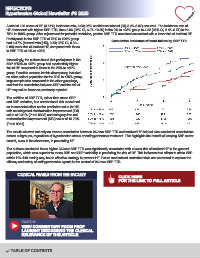
     A total of 186 cases of HF (3.61%; incidence rate, 6.03; 95% confidence interval [CI], 5.23–6.97) occurred. The incidence rate of
     HF decreased with higher SBP TTR, from 8.06 (95% CI, 6.07–10.69) in the 0% to <25% group to 4.32 (95% CI, 2.85–6.57) in the
     75% to 100% group. After adjustment for potential variables, greater SBP TTR remained associated with a lower risk of incident HF.
                                                                                                                   Hypertension
     Participants in the SBP TTR of 75% to 100% group
     had a 47% (hazard ratio [HR], 0.53; 95% CI, 0.32–               Cumulative incidence of heart failure by SBP TTR
     0.89) lower risk of incident HF, compared with those
     in SBP TTR of 0% to <25%.

     Interestingly, the authors found that participants in the
     SBP of 50% to <75% group had a potentially higher
     risk of HF compared to those in the 25% to <50%
     group. Possible reasons for this discrepancy included
     an older patient population for the 50% to <75% group,
     large sample size compared to the other groupings,
     and that the association between SBP and the risk of
     HF may not be linear as previously reported.

     The addition of SBP TTR, rather than mean SBP
     and SBP variation, to a conventional risk model had
     an incremental effect on the predictive value for HF,
     with an integrated discrimination improvement (IDI)
     value of 0.31% (P = 0.0003) and category-free net
     reclassification improvement (NRI) value of 19.79%
     (P = 0.0081).


     The results showed not only an inverse association between 24-hour SBP TTR and incident HF risk but also consistent associations
     across subgroups, regardless of hypertension status or antihypertensive treatment. This highlights the benefit of keeping SBP under
     control, even in the short-term, in preventing HF.

     The authors concluded that a higher 24-hour SBP TTR was significantly associated with a lower risk of incident HF in the general
     population, which was superior to mean SBP and SBP variability in predicting the risk of HF. This indicates that efforts to attain SBP
     within 110–140 mmHg may be an effective strategy to prevent HF. Future randomised controlled trials are warranted to explore the
     efficacy and safety of antihypertensive agents in the control of 24-hour SBP TTR.


            CLINICAL PEARLS FROM THE FACULTY                             CLICK HERE
                                                                         FOR THE LINK TO FULL ARTICLE


              WATCH
              VIEW COMMENTARY FROM PROF.
              LAURENT DISCUSSING THE CLINICAL
              RELEVANCE OF THE ARTICLE.


          TABLE OF CONTENTS

